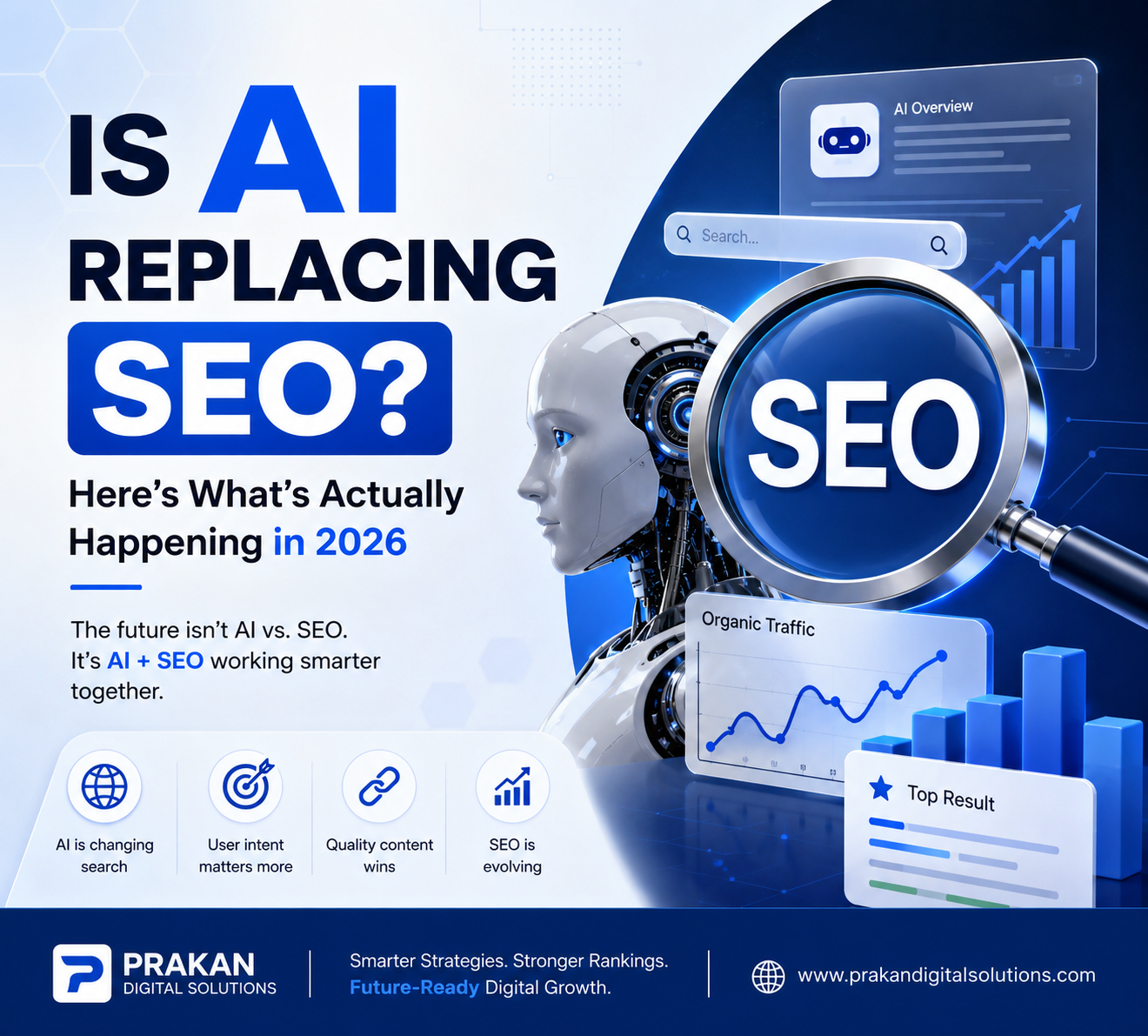
Artificial Intelligence (AI) has transformed the digital marketing landscape. From content creation to keyword research and customer support, AI tools are making marketing faster and more efficient than ever. But one question continues to dominate discussions: Is AI replacing SEO?
It’s a reasonable question. Indeed, AI tools create content, give keyword suggestions, and create meta descriptions almost instantaneously. However, at Prakan Digital Solutions, we use this technology on a daily basis, and here is what we find out in practice: AI has not substituted the need for SEO. It’s changed the job description.
So, Is AI Replacing SEO?
Actually, no, but it does do much of the grunt work that used to keep SEO professionals busy throughout the week. Therefore, it is better to think of AI as a very swift but a bit too confident assistant rather than a replacement. It is capable of drafting texts, summarizing them, and organizing them. However, AI cannot determine what exactly businesses should say or why anyone would believe them.
Why SEO Looks So Different Than It Did a Few Years Ago
Search itself has changed shape. Ranking used to be mostly a numbers game — the right keywords, enough backlinks, done. Now Google’s algorithms are reading for intent, quality, and whether a site actually knows what it’s talking about.
On top of that, AI-generated answers now show up directly in search results. That means content doesn’t just need to rank — it needs to be good enough that an AI system would want to reference it. That’s a higher bar than it sounds like.
Where AI Genuinely Helps
Give AI credit where it’s due. It’s gotten legitimately useful for:
- Keyword research and clustering
- First-draft content outlines
- Meta titles and descriptions
- Technical SEO audits
- Competitor scans
- Spotting search trends early
These are real time-savers. But every one of them still needs a person checking the output, because AI is only as good as the data and instructions it’s working from — and it doesn’t know your business, your customers, or your voice unless you tell it.
What AI Still Can’t Do
Strategy. Picking the right SEO approach means understanding your goals, your competitors, and how your actual customers search and decide. That’s judgment, not a template.
Original thinking. AI content tends to sound like AI content — competent, but generic. It doesn’t tell stories or make people feel something the way a person writing from real experience can.
Reading the customer. Good SEO solves a real problem for a real person. AI can guess at intent; it can’t understand it the way someone who’s actually talked to your customers can.
Brand voice. Your business doesn’t sound like every other business in your industry — or at least it shouldn’t. That personality has to be written in on purpose.
E-E-A-T. Google’s ranking systems increasingly reward genuine experience and expertise. That’s not something you can prompt your way into; it has to be real.
The Rise of AI-Powered Search
More people are searching through ChatGPT, Google AI Overviews, Gemini, and Perplexity instead of a traditional search bar. That’s given rise to two newer disciplines:
- Answer Engine Optimization (AEO)
- Generative Engine Optimization (GEO)
Both are about making sure AI systems see your brand as a trustworthy source worth citing. They’re an extension of good SEO, not a replacement for it — the fundamentals (helpful, credible, well-structured content) still do the heavy lifting.
What a Strong 2026 SEO Strategy Actually Looks Like
The businesses pulling ahead right now are the ones combining AI’s speed with real expertise. That means:
- Writing original, genuinely expert content
- Understanding what customers are actually searching for and why
- Keeping the site fast and mobile-friendly
- Earning quality backlinks
- Using structured data properly
- Updating content instead of letting it go stale
- Using AI to move faster — without letting quality slip
Final Thoughts
AI isn’t replacing SEO. It’s raising the stakes for what “good” content looks like.
Businesses that lean entirely on AI-generated content tend to hit a ceiling — the content is fine, but nothing builds trust or authority. The ones that pair AI’s efficiency with real SEO expertise are the ones building something that actually lasts.
At Prakan Digital Solutions, that’s the balance we help clients strike — using AI where it earns its keep, and keeping people in charge of strategy, voice, and trust. If you’re ready to build an SEO approach that holds up in the age of AI search, let’s talk.
FAQ
1. Is AI going to replace SEO professionals?
No. AI automates certain tasks, but strategy, brand voice, and building genuine authority still require human expertise.
2. What is AEO and GEO?
Answer Engine Optimization and Generative Engine Optimization are practices focused on getting your content referenced by AI-powered search tools like AI Overviews and ChatGPT. They work alongside traditional SEO, not instead of it.
3. Should I use AI-generated content on my website?
AI can speed up drafting, but content should always be reviewed, fact-checked, and shaped by someone who understands your brand and audience.
4. What does Google’s E-E-A-T mean for AI content?
Google rewards content that reflects real experience and expertise. Purely AI-generated content without human input or oversight tends to struggle here.